


Try the super easy mosaic knitting technique and knit these beautiful wintery wool socks
Created by Finnish knitwear designer Pirjo Iivonen, these blue-and-white socks are made using a technique called mosaic knitting. This technique allows you to knit patterns with one color at a time, which makes it great for those unsure about trying traditional colorwork.
Size: EU 36–41. The size is easy to adjust by changing the foot width and length.
Ahtojää socks: supplies
- About 130 g of medium-weight sock yarn. The sample socks were knitted with Novita Nalle (100 g / ca. 260 m) in shades denim (160) and white (011).
- 3 mm (US 2.5) double-pointed needles for the leg and 2.5 mm (US 1.5) for the foot, or as needed to meet gauge.

How to knit the Ahtojää socks

Leg
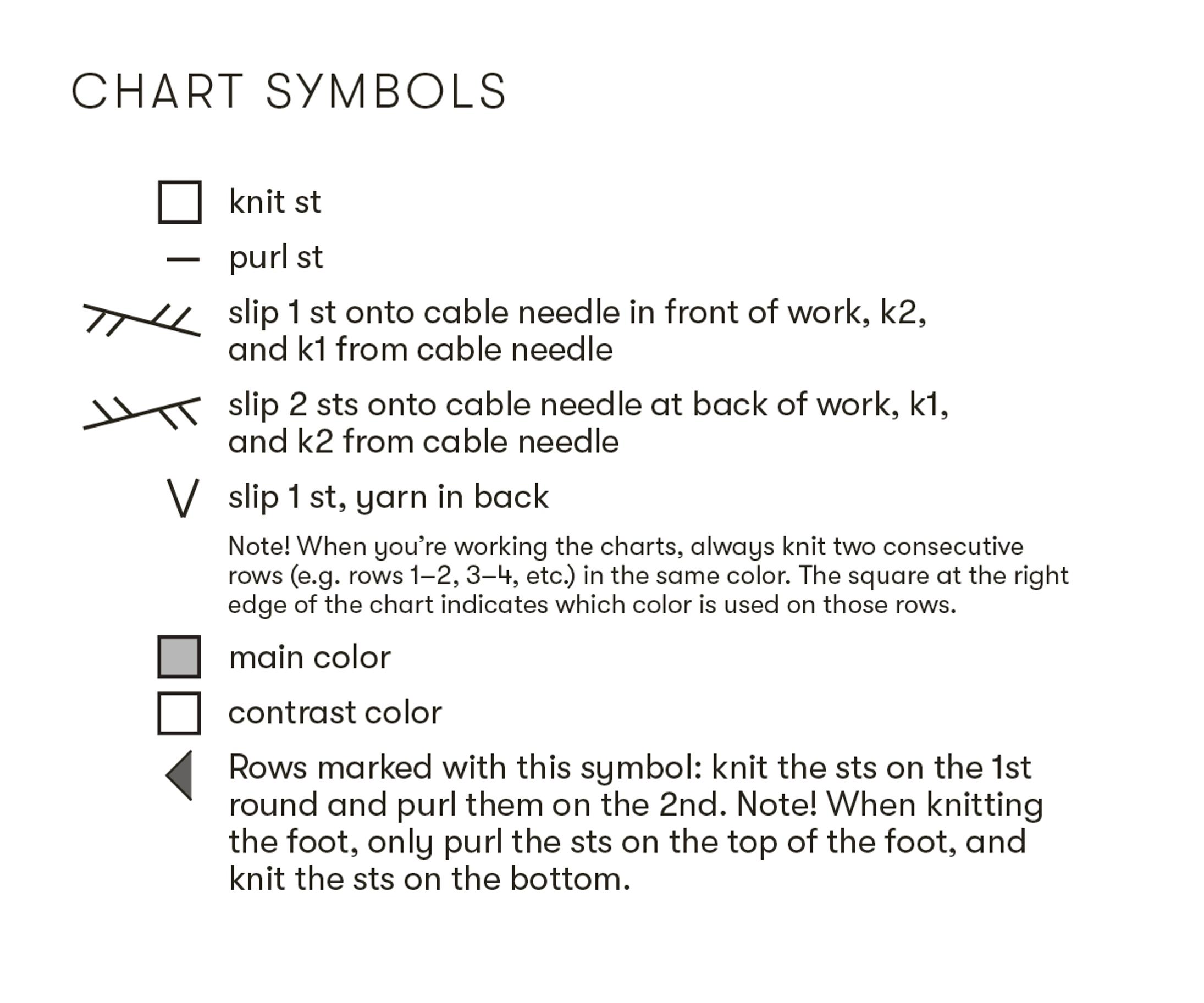
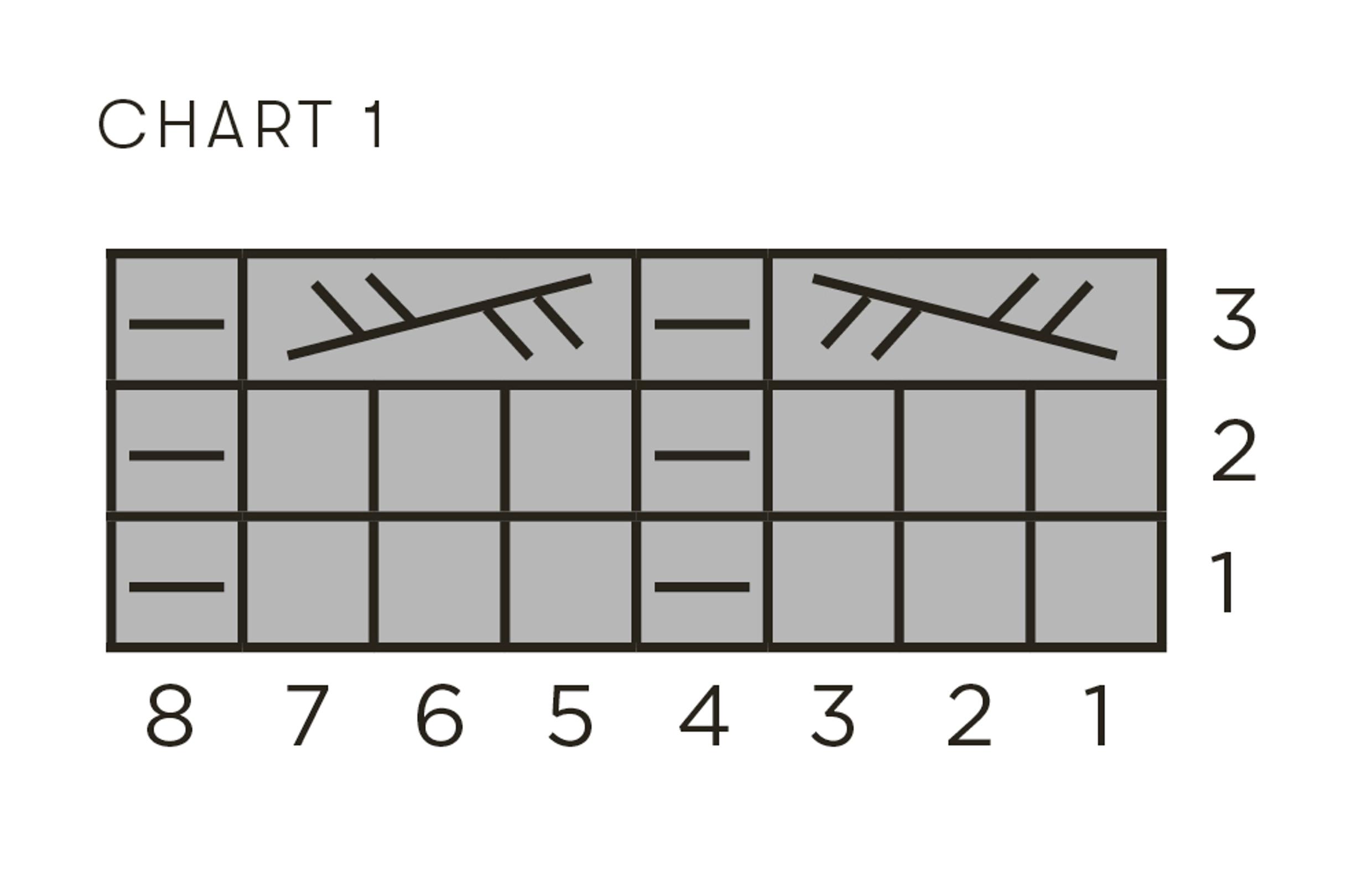
Cast on 64 sts with the main color, dividing them evenly on four needles (16 sts each). Join to work in the round, making sure your work doesn’t get twisted. Work Rounds 1–3 of Chart 1 five times total in the main color. Chart 1 repeats 8 times per round.

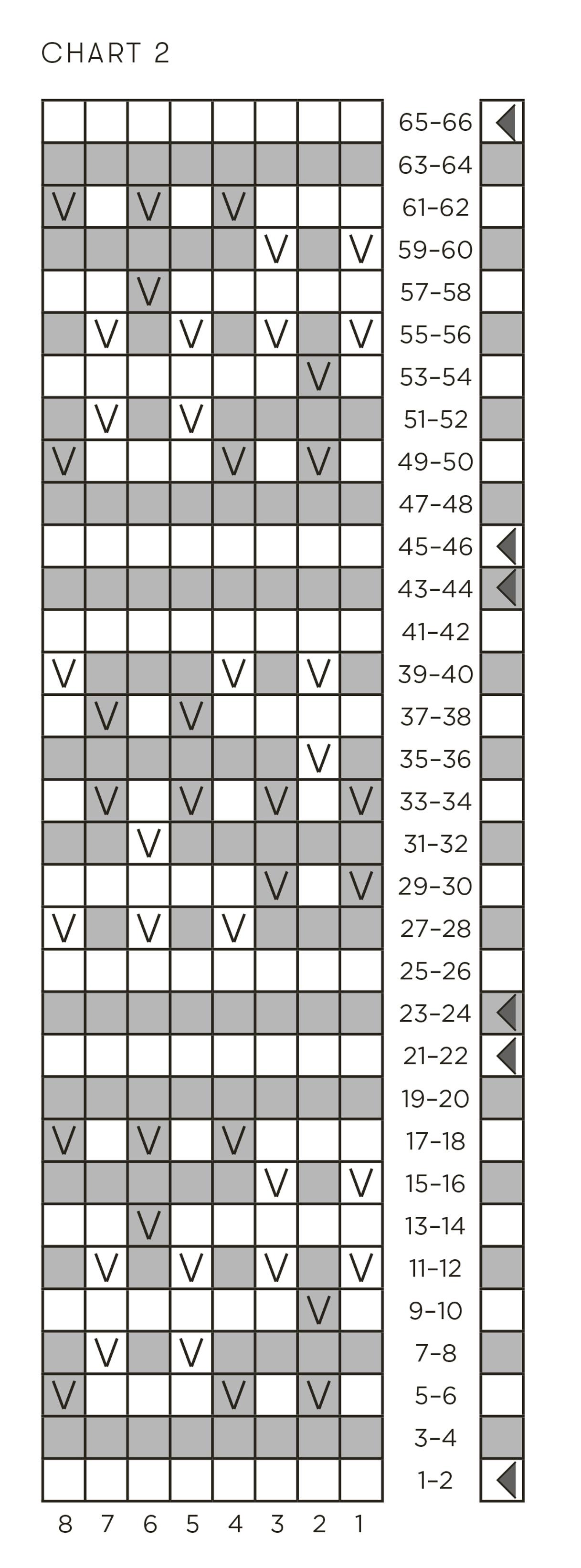
Knit one round over all sts, join the contrast color, and start working Chart 2. Note that Chart 2 is mosaic knitting, so each chart row represents two rounds. On the rows marked with a triangle, you’ll knit the first round and purl the second. Chart 2 is repeated 8 times per round.
After finishing Chart 2, break the contrast yarn and switch to the smaller needles. Knit one round over all sts with the main color. Then work Rounds 1–3 of Chart 1 five times total. Knit one round over all sts and at the same time, make decreases so that when 4 sts remain on each needle, k2tog, then k2. You now have 60 sts total (15 per needle).
Heel and heel turn
Work the heel flap back and forth over the sts on needles III and IV (30 sts) in reinforced stitch. Move sts from needle III to needle IV for the heel. First, on the WS row, slip 1 st purlwise, purl to the end, then turn. Continue in reinforced stitch on Rows 1–2 as follows:
Row 1 (RS): *slip 1 st, k1*, repeat *–* to end.
Row 2 (WS): slip 1 st, purl to end. Keep repeating these two rows until you have 30 rows or the flap measures about 5.5–6 cm. End with a WS row.
Work the heel turn as follows:
Row 1 (RS): slip 1 st knitwise, continue in reinforced stitch until 10 sts remain, then ssk (slip 2 sts knitwise one at a time, return them to the left needle, knit them through the back loop), turn.
Row 2 (WS): slip 1 st purlwise, p10, p2tog, turn.
Row 3 (RS): slip 1 st knitwise, k10 in reinforced stitch, ssk, turn. Keep repeating Rows 2 and 3 until you have made the last decreases at the very ends of the final WS and RS rows. Then split the remaining heel sts evenly onto two needles (6 sts each). Pick up about 15 sts along both sides of the flap. Move the two outermost sts of the top of the foot (needles I and II) to the bottom of the foot. Now needles I and II each have 14 sts.


Gusset decreases
Continue working in the round with the main color on all needles.
On the first round, knit all sts. On the second round, ssk at the start of needle III, and k2tog at the end of needle IV. Make these gusset decreases every other round and work stockinette on the rounds in between.
Continue until there are 56 sts total (14 on each needle). You can narrow the foot more by making additional gusset decreases, which reduces the total st count. The toe motif is divisible by four, so keep that in mind if you change the stitch count. Remember to also adjust and move the sts between needles before starting the toe decreases; the top and bottom of the foot should have the same number of sts.

Foot and toe decreases
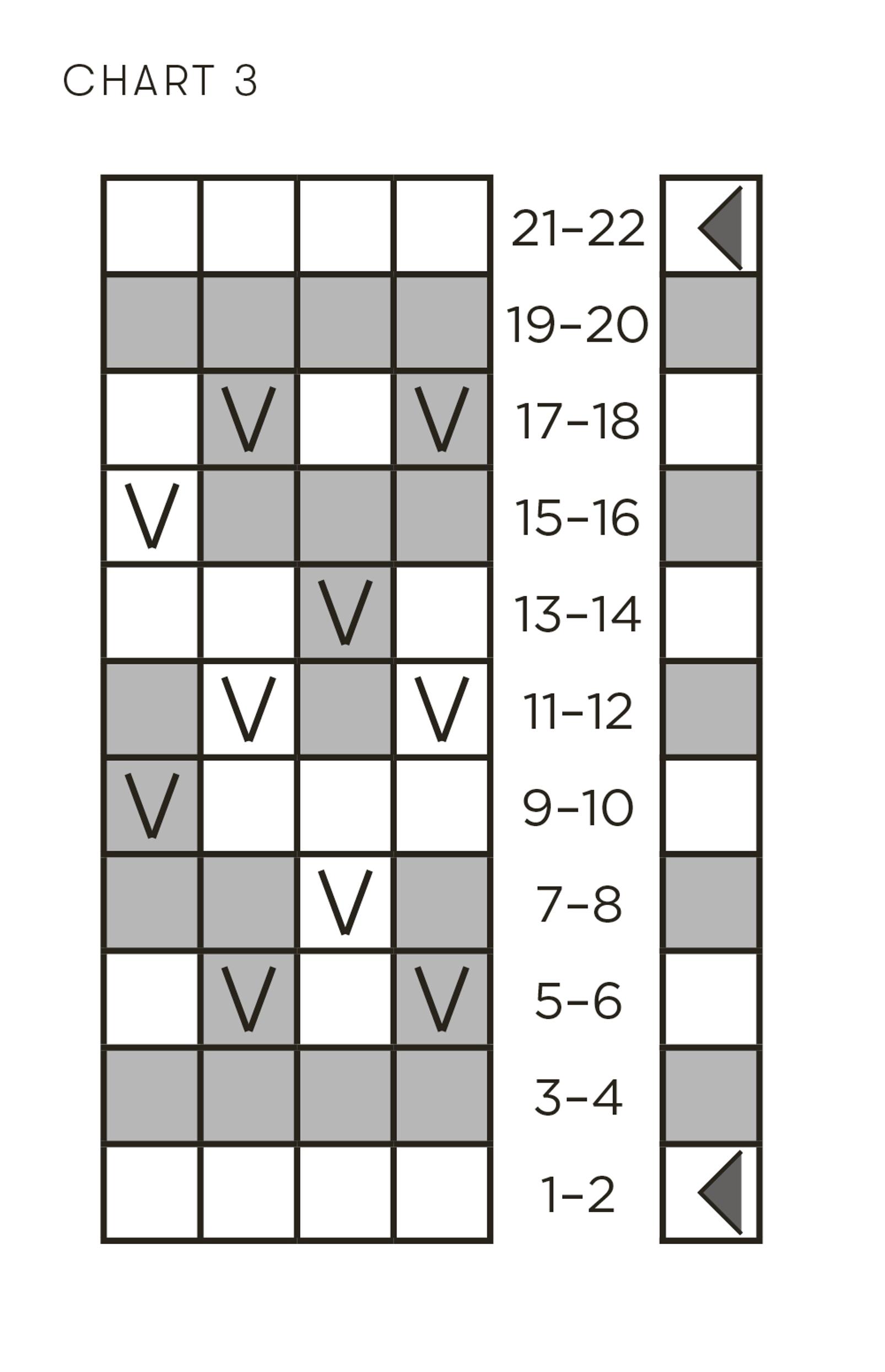
Work stockinette on all sts until the foot length is about 10 cm less than the final sock length. Then join the contrast color and follow Chart 3. Note that on Rounds 2 and 22, you purl only the top-of-foot sts while knitting the sole sts. After Chart 3, break the contrast yarn and knit two rounds on all sts.
Begin the toe decreases. At the beginning of needles I and III, k1, ssk, then knit to the end of needle. On needles II and IV, knit until 3 sts remain, k2tog, k1. Make these decreases every other round and knit the in-between rounds. When you have 7 sts on each needle, decrease on every round. Continue until 2 sts are left on each needle. Break the yarn, pull it through the remaining sts, and tighten.
Knit the second sock the same way. Note: You can knit the heel on needles I and II if you want to place the round change on the sock’s inner side.
Finishing
Weave in the ends. If there are any gaps at the gusset decreases, you can sew them up with a tapestry needle. Lightly steam the socks at low heat through a damp cloth.
If you’d like, make two tassels and attach them at the lower edge of the cuff.


Mosaic knitting, or knitting with slipped stitches
In mosaic knitting, or slipped-stitch knitting, you work one color at a time, and the pattern forms from elongated stitches created by slipping stitches. This is a great option if you want colorwork-like patterns in your knit without having to delve into traditional stranded knitting.
In the mosaic charts of this sock pattern, one chart row represents two knitted rows. This is because the two knitted rows are worked the exact same way.
On the right edge of each chart row, next to the row number, there’s a colored box indicating which yarn color is used on that row. You don’t knit this box; it’s simply there to help you choose the correct color. Slipped stitches are indicated with a V symbol in the charts.
Pattern design and execution: Pirjo Iivonen

